Beyond Robert's Rules: Building Humble Boards That Transform Governance

Did you miss our Community Call? Watch it here.
What if effective governance was less about rules and procedures and more about how we relate to one another?
That question sits at the heart of the Humble Board framework, introduced by organizational development consultant Lon Swartzentruber. Rather than focusing solely on structures, agendas, and parliamentary procedure, the Humble Board invites organizations to cultivate the human skills that make governance effective: humility, listening, and curiosity.
The Honeycomb Model
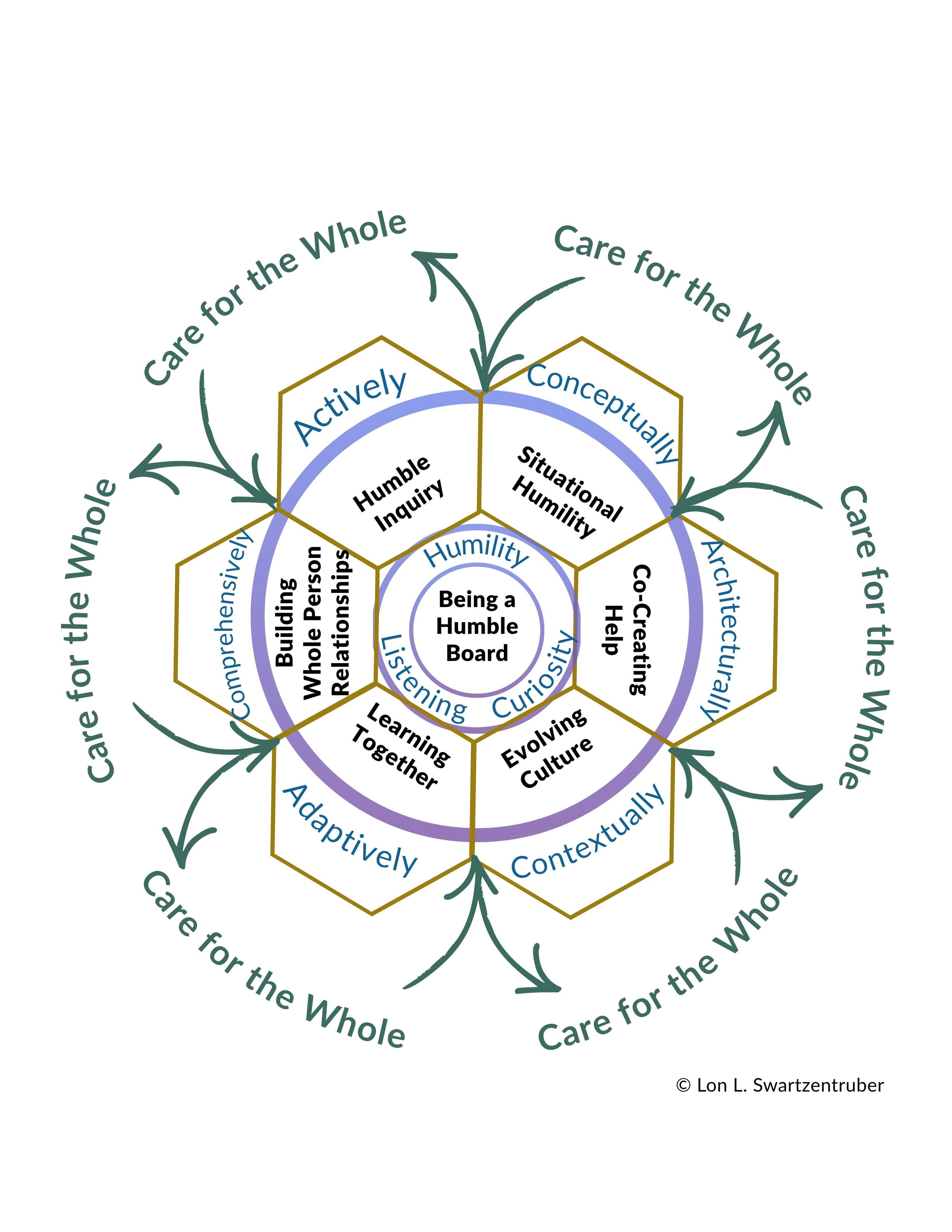
The Humble Board uses a honeycomb as its guiding image. Each cell represents a healthy governance behavior, while the entire structure reminds us that strong organizations are built through relationships and interconnectedness.
At the center are three foundational practices:
Humility – recognizing that we do not have all the answers.
Listening – seeking to understand before responding.
Curiosity – asking genuine questions rather than defending positions.
These qualities create the foundation for healthy governance regardless of the board structure being used.
Six Healthy Board Behaviours
The framework identifies six behaviours that strengthen board culture:
1. Humble Inquiry
Asking genuine questions and listening deeply rather than assuming we already know the answer. This creates a culture of learning and openness.
2. Situational Humility
Recognizing that there may be factors, perspectives, or dynamics we do not fully understand. This helps boards move beyond certainty toward shared understanding.
3. Whole-Person Relationships
Showing up as human beings, not simply as roles or titles. Strong relationships create trust and psychological safety, allowing boards to navigate conflict more effectively.
4. Co-Creating Help
Moving away from expert-driven solutions and toward collaborative problem solving. This approach recognizes that everyone brings wisdom and agency to the conversation.
5. Learning Together
Acknowledging that people are at different stages of growth and experience. Healthy boards create space for ongoing learning, innovation, and adaptation.
6. Evolving Culture
Recognizing that culture is shaped over time through shared learning and behaviour. Boards can intentionally shape culture by examining assumptions and aligning actions with their values.
Care for the Whole
The Humble Board framework extends beyond the boardroom. Drawing on the African principle of Ubuntu—"I am because we are"—it reminds leaders that organizations exist within larger communities and ecosystems.
Healthy governance requires attention not only to internal concerns but also to staff well-being, community needs, social trends, and the wider environment. Board members become learners who bring insights from the broader world back to the organization.
Why It Matters
The Humble Board does not replace governance structures such as Robert's Rules or consensus decision-making. Instead, it provides the human foundation that allows any governance system to function well.
In a time when many organizations struggle with conflict, polarization, and inherited structures, the Humble Board offers a simple but challenging invitation: focus first on relationships. Ask better questions. Listen more deeply. Remain curious. Build trust.
Ultimately, governance is not only about making decisions. It is about creating the relationships and culture that make good decisions possible.
To learn more about the Humble Board framework, or to explore how it might transform your organization's governance, visit Lon's website www.acausegreater.org or reach out to your retreat center network. The fall season brings new opportunities for learning, onboarding with intention, and building boards that can truly care for the whole.
Watch this community call here. Here is a pdf of the presentation.
